Assay Principle:
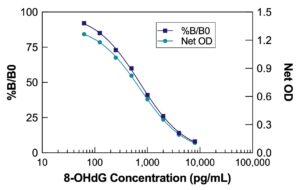
The DetectX® DNA Damage ELISA Kit quantitatively measures DNA and RNA oxidized guanosine species in serum, plasma, saliva, urine, and fecal extracts. This competitive ELISA has a run time of 2.5 hours. Please read the complete kit insert for more information before performing this assay. Use our provided 8-Hydroxy-2’-deoxyguanosine (8-OHdG) standard to generate a standard curve for the assay.
Protocol Summary:
- Introduce standards or diluted samples into the included transparent microtiter plate pre-coated with goat anti-rabbit IgG antibody.
- Add 8-hydroxyguanosine (8-OHG) conjugate and the peroxidase-labeled mouse monoclonal antibody to each well, ensuring thorough mixing.
- Incubate at room temperature, covered and shaking, for 2 hours. The immunological reaction inversely correlates with the 8-OHdG concentration in the sample.
- Post-incubation, remove excess conjugate and add the TMB substrate. The substrate reacts with the bound conjugate, creating a detectable colorimetric signal.
- Utilize a plate reader to measure the signal intensity at 450nm and calculate the 8-OHdG concentration using the standard curve.
Background:
Reactive oxygen species (ROS) and other free radicals are continuously generated in biological systems as a byproduct of normal cellular metabolism and exposure to environmental stressors such as ultraviolet and ionizing radiation. These reactive species can induce oxidative damage to nucleic acids, proteins, and lipids. Cellular antioxidant defenses and DNA repair pathways act to limit the accumulation of oxidative damage and preserve genomic integrity.
Oxidative damage to nucleic acids frequently affects the DNA base guanine, which is particularly susceptible to oxidation. Damaged bases are removed through base excision repair and related repair mechanisms, generating oxidized nucleosides and nucleobases. 8-hydroxy-2′-deoxyguanosine (8-OHdG) is one of the most widely used biomarkers of oxidative DNA damage. These repair products are further processed into stable metabolites that circulate in the blood and are excreted in urine or saliva.