

The role of corticosterone in immune adaptation to high altitudes
High altitudes come with plenty of well-known challenges – running, baking, and boiling water all become more difficult at higher elevations. Perhaps less widely appreciated is the impact of elevation on the immune system. Living at higher altitudes may lead to changes in the immune response to infection.
In response to climate change, common disease vectors like mosquitos are expanding their habitats to higher elevations. This shift could lead to increased pathogen exposure and more frequent infections for those living at higher elevations. Thus, it is critically important to understand how elevation alters the immune response as it will have important implications for humans and animals at higher elevations as pathogens shift into those areas.
Deer mice are important reservoirs for tick-borne illnesses such as Lyme disease and hantavirus, meaning they carry harmful parasites and bacteria but generally do not become sick from them due to unique immune responses. As climate change shifts animal habitats, understanding how the immune systems of disease reservoirs like deer mice may change at higher altitudes becomes more important.
Studying the high-altitude immune response
Recent research addressed this need by investigating the immune responses of deer mice descended from a mountain population compared to deer mice descended from a lower-altitude Great Plains population. Rather than studying the captured mice immediately, the researchers bred both populations for several generations in the laboratory after being collected from their habitats. This experimental design allowed the authors to test whether the impacts of high elevation on the immune system could be passed from one generation to the next, even after transferring to a lower altitude.
To study the immune response, the researchers injected the mice with lipopolysaccharide (LPS), a molecule found on the surface of many bacteria that causes inflammation and a fever response. They observed lower fevers in the mice with high-altitude ancestry, suggesting that high altitudes may lead to a blunted inflammatory response.
To investigate changes in the immune system, the researchers measured gene expression in the immune cells from high-altitude ancestry mice. Overall they identified very few differences in the LPS-induced gene expression between the two mouse populations.
High-altitude ancestry mice have elevated corticosterone levels
Finally, the authors investigated whether hormonal differences might explain the lower fever response in high-elevation ancestry mice. Corticosterone is a hormone that can suppress various elements of the immune system.
These researchers used the Arbor Assays Corticosterone Multi-Format ELISA kit to quantify corticosterone in the serum of mice after LPS injection. The high-elevation ancestry mice had substantially higher levels of corticosterone both before and after LPS injection when compared to low-elevation ancestry mice.
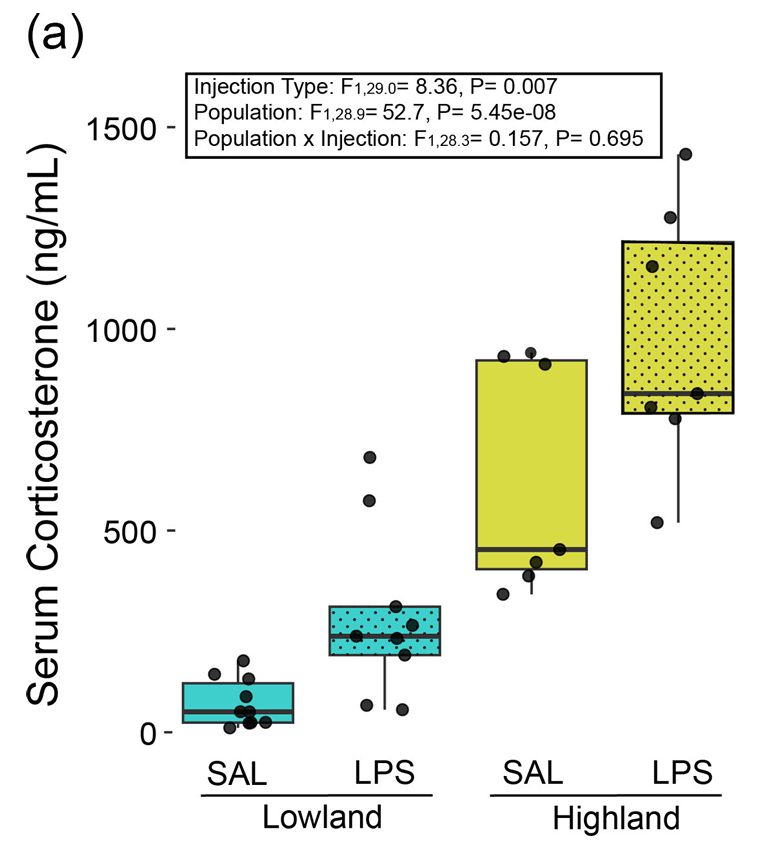
Figure 4A. Serum corticosterone collected from lowland (blue) and highland-ancestry (yellow) deer mice 4 h following injection with saline (solid) or LPS (dotted) 4 h prior to tissue harvest. Effects of ancestry and injection on serum corticosterone were considered significant at p < 0.05 when evaluated using ANOVA. Figure from Butler et al, 2026.
Understanding the interplay of high elevation, corticosterone, and immune responses
Climate change has the potential to alter the pathogen landscape at higher altitudes, and understanding how elevation impacts immune responses will be critical for human health and species conservation in response to these threats. Corticosterone is elevated in high-altitude ancestry mice and impacts immune responses, making it a critical link in understanding how changes in elevation can affect the immune system that requires further study.
Arbor Assay supports corticosterone quantification across a variety of species, making it well-suited to understanding the immune responses in both wild and laboratory animals. Investigating the interactions between hormonal and immune responses across species will provide critical insights into immune system adaptation driven by climate change.
________
By: Belle Henry-Kanarek
Edited By: Charukesi Sivakumar and Courtney Myers
Related Products
-
 In Stock
Corticosterone Multi-Format ELISA Kit
Price range: $375.00 through $1,499.00The DetectX® Corticosterone Multi-Format ELISA Kits quantitatively measures corticosterone present in a variety of samples.