
Matrix Interference: Validating Cortisol Measurements in Dolphin Saliva
Matrix interference is one of the most common yet overlooked causes of distorted ELISA data.
An assay that performs well in serum or plasma won’t automatically behave the same way in saliva, fecal extracts, hair, or other biological matrices. Every matrix contains unique proteins, salts, lipids, and enzymes that can alter antibody binding or signal detection.
If you’re expanding into a new sample type, validation is essential. Here’s what proper matrix validation looks like in practice.
Case Study: Validating Salivary Cortisol in Dolphins
In a recent 2025 Marine Mammal Science study, Charlton et al. validated salivary cortisol as a proxy for blood cortisol in bottlenose dolphins.
Before establishing saliva as a matrix, the researchers performed three critical experimental protocols.
1. Spike and Recovery
They confirmed plasma as the benchmark by spiking pooled plasma with known cortisol concentrations before extraction and measured recovery:
- 78.6% recovery at low spike volumes
- 72.2% recovery at higher spike volumes
A consistent recovery of ~70–120% typically indicates minimal matrix interference and confirms that the assay can accurately detect the hormone in that sample type.
2. Parallelism Testing
Next, they included the new matrix, saliva, in testing that compares expected dilution measurements to that of the assay’s provided standard. Serial dilutions of pooled saliva or plasma extracts were compared to the assay’s standard curve. Statistical testing confirmed parallel slopes (p = 0.304).
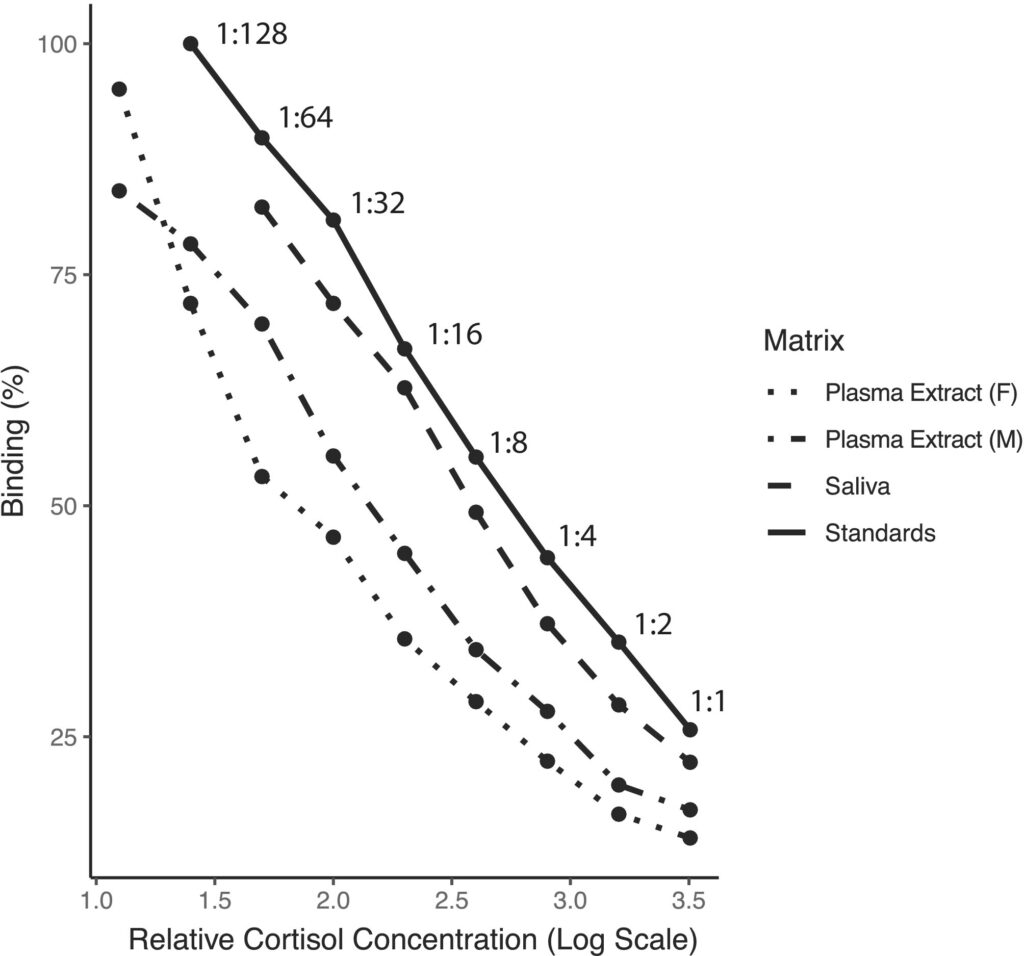
Parallelism indicates that the hormone in the sample binds to the assay antibody in the same way as the standard—non-parallel curves flag matrix interference.
3. Biological Validation
Finally, the researchers also confirmed that saliva captured real physiological changes.
Paired blood and saliva samples were collected:
- 24 hours before a controlled stress event
- During an out-of-water veterinary procedure
- 24 hours after
Plasma cortisol increased from 3.65 ng/mL to 17.33 ng/mL during the procedure and returned to 3.93 ng/mL 24 hours after the stressor, while salivary cortisol also increased from 0.13 ng/mL to 0.39 ng/mL, returning to 0.09 ng/mL.
Both matrices showed significant elevation during the stressor and returned to baseline afterward. This confirmed that salivary cortisol measurements were not significantly distorted by matrix interference and provided biologically responsive data.
How to Validate a New Matrix
In summary, if you’re introducing a new sample type into your workflow, use this framework:
- Assess recovery. Spike known analyte into the matrix and confirm 70–120% recovery.
- Test parallelism. Serially dilute pooled samples and compare slopes to the standard curve.
- Confirm dynamic range. Ensure concentrations fall within the assay’s linear detection window.
- Demonstrate biological relevance. Show expected changes in response to a known physiological stimulus.
Skipping biological validation risks publishing technically sound but biologically misleading data.
Cortisol ELISA Kits by Arbor Assays
The dolphin study used the DetectX® Cortisol ISWE Mini Kit (ISWE002) to validate saliva as a matrix for cortisol analysis. Notably, saliva samples were analyzed without extraction, while plasma samples required extraction before analysis, illustrating how matrix characteristics can influence sample preparation strategy.
Matrix validation is not only about confirming compatibility. It informs extraction requirements, dilution factors, assay sensitivity, and interpretation of final concentrations. By validating saliva as an alternative matrix, the researchers in this study enabled:
- Less invasive sampling
- More frequent monitoring
- Repeated measures without additional stress
- Improved welfare assessment through longitudinal data
For broader research applications, the Cortisol ELISA Kit (K003-H) supports serum, plasma, urine, saliva, fecal extracts, hair, feather, and tissue culture media. Expanding into additional matrices can increase experimental flexibility, provided each new matrix undergoes recovery testing, parallelism assessment, and biological validation before being incorporated into the study’s design.
Continue Exploring
- Browse: Research Resources for extraction guides and publications
- Explore: Cortisol ELISA Kit page for matrix compatibility details
Featured Products
-
 In Stock
Cortisol ELISA Kit
Price range: $346.00 through $1,388.00The DetectX® Cortisol ELISA Kits quantitatively measure cortisol present in a variety of samples.