

PGE2 Measurement Links Immune Signaling to Tissue Regeneration
Prostaglandin E2 (PGE2) as a biomarker sits at a critical intersection of inflammation and tissue repair. However, its role in coordinating immune-driven regeneration is still being defined.
A recent study published in Cell Regeneration demonstrates how precise quantification of PGE2 can uncover the mechanisms behind stem cell–driven regeneration. Using an ELISA-based approach, researchers showed that PGE2 is essential for coordinating immune responses that enable tissue recovery.
Tracking PGE2 in a Regenerative Model
In this study, researchers used zebrafish larvae, a well-established vertebrate model for studying regeneration, to evaluate how mesenchymal stromal cells (MSCs) influence tissue repair. Following fin amputation, murine MSCs were introduced at the injury site, and regeneration was monitored over several days.
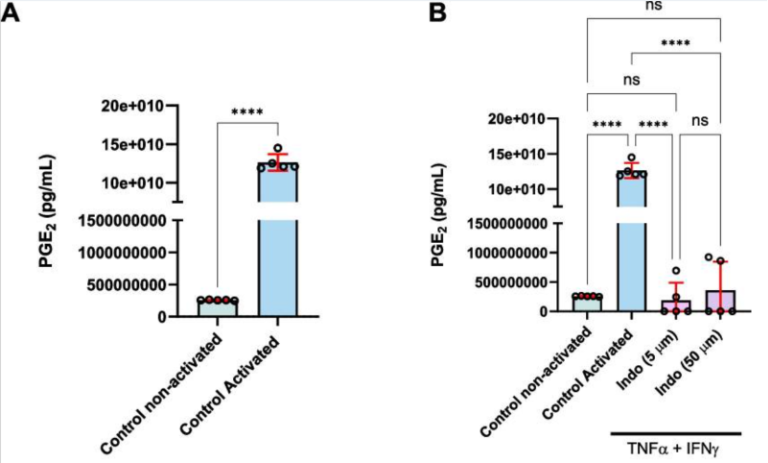
To understand the underlying mechanism, the team quantified PGE2 secretion from MSCs under different conditions using Arbor Assays DetectX® Prostaglandin E2 (PGE2) ELISA Kit (K051-H). Baseline PGE2 production was low, but stimulation with inflammatory cytokines (TNF-α and IFN-γ) significantly increased secretion (p < 0.0001). This suggests inflammatory activation directly drives PGE2-mediated signaling in MSCs.
PGE2 Links Immune Response to Regenerative Outcomes
ELISA-based measurement of PGE2 helped connect molecular signaling to events at the tissue level. When PGE2 production was inhibited with indomethacin, the regenerative benefit of MSCs was lost, with significantly reduced fin length and area (p < 0.001–0.0001).
Key findings included:
- Controlled inflammatory response: MSCs increased macrophage recruitment early in the healing process, including pro-inflammatory (tnfa+) cells. Under normal conditions, this response resolved quickly. When PGE2 was inhibited, pro-inflammatory macrophages remained elevated at later time points.
- Timing matters for regeneration: Effective tissue repair depended on a short-lived inflammatory phase followed by resolution. Disrupting PGE2 signaling prolonged inflammation and impaired regrowth, highlighting its role in coordinating this transition.
- MSC survival at the injury site: MSCs lacking PGE2 were more readily cleared by macrophages, reducing their persistence and limiting their ability to support regeneration through signaling and cell–cell interactions.
- MSC-derived PGE2 drives the effect: Gene expression analysis showed minimal endogenous PGE2 production in regenerating tissue, suggesting that the observed effects are primarily driven by MSC-derived PGE2.
Across conditions, PGE2 appears to serve two functions: regulating the inflammatory phase and supporting MSC persistence at the injury site. Accurate, quantitative measurement by ELISA was key to establishing this connection and moving beyond observation to mechanism.
Why Measure PGE2 in Regenerative Research
PGE2 is rapidly synthesized and degraded, and studies show that small differences in handling or timing can significantly impact measured levels. This sensitivity to experimental conditions makes assay consistency critical for meaningful comparisons.
A well-validated ELISA enables researchers to:
- Detect subtle changes in PGE2 production under different stimuli
- Compare baseline and activated conditions with confidence
- Link biochemical signaling to functional biological outcomes
- Generate data that supports mechanistic conclusions and publication
Whether studying stem cell therapies, inflammation, or tissue repair, reliable measurement of PGE2 provides a direct window into immune-regenerative crosstalk.
Advancing Insight Through Quantification
This work reinforces the value of integrating biomarker quantification into experimental design. As regenerative medicine continues to evolve, tools that quantify key signaling molecules will remain essential for translating complex biology into actionable insights.
Explore how the DetectX® PGE2 ELISA Kit supports quantitative measurement and discover additional PGE2 studies in our publication database.
Featured Products
-
 In Stock
Prostaglandin E2 (PGE2) ELISA Kit
Price range: $484.00 through $1,934.00The DetectX® Prostaglandin E2 (PGE2) ELISA Kits quantitatively measure PGE2 present in serum, plasma, urine, saliva and tissue culture media samples.
Related Products
-
 In Stock
Cyclic AMP Direct ELISA Kit
Price range: $457.00 through $1,828.00The DetectX® Cyclic AMP (cAMP) Direct ELISA Kits quantitatively measure cAMP present in a variety of samples.
-
 In Stock
Nitric Oxide (NO) Colorimetric Detection Kit
$335.00The DetectX® Nitric Oxide (NO) Detection Kit is designed to quantitatively measure Nitrate and Nitrite present in a variety of samples.