

A NEW POSTPARTUM DEPRESSION MODEL EVALUATES FAST-ACTING TREATMENTS
Mention pregnancy or postpartum hormones, and oxytocin often sits in the spotlight: oxytocin driving labor contractions, oxytocin released during breastfeeding, oxytocin celebrated for maternal bonding.
Yet despite oxytocin’s fame for lowering the risk for postpartum depression (PPD), it isn’t the key to treating it. That role belongs to a lesser known neurosteroid: allopregnanolone.
Derived from progesterone, allopregnanolone levels skyrocket during pregnancy to regulate maternal mood and stress. When the placenta detaches during childbirth, allopregnanolone levels plummet, triggering a rapid neurochemical shift in emotional stability. While researchers are still unravelling how this biological crash influences vulnerability to PPD, synthetic allopregnanolone to restore these levels is currently the only FDA-approved treatment specifically for PPD.
While effective, allopregnanolone-based drugs do not come without side effects. Whether administered as a 60-hour hospital IV infusion or a newer daily pill, they carry strict warnings regarding sedation and impaired alertness, making daily infant care challenging for a recovering mother.
THE SEARCH FOR FAST-ACTING ALTERNATIVES
Since this neurochemical shift occurs so rapidly, traditional antidepressants (like SSRIs) often fall short. SSRIs target general neurotransmitters like serotonin and take weeks to kick in, which is a timeline far too slow for a mother experiencing a sudden postpartum crash. To bridge this gap, researchers are exploring alternative rapid acting mechanisms, including glutamate modulators like ketamine.
In clinical research settings, ketamine has drawn interest for its ability to relieve severe depressive symptoms in hours rather than weeks. While ketamine carries its own risks and safety considerations, its unique mechanism provides scientists with a valuable model for studying how fast-acting glutamate modulation compares to traditional neurosteroid therapies in PPD.
But the question remains: can a general glutamate modulator match the therapeutic effectiveness of a targeted neurosteroid model? A recent study by García-Baos et al. set out to answer that exact question, evaluating ketamine head-to-head against the gold standard, allopregnanolone, for PPD treatment.
BUILDING A BETTER MOUSE MODEL FOR PPD
Testing fast-acting treatments requires an animal model that reflects the human experience of PPD. While stress-based models like Maternal Separation with Early Weaning (MSEW) have long been established in rats, researchers studying PPD in mice often had to rely on artificial methods like harsh physical restraints. These approaches missed the complex psychological and social stress experienced by postpartum mothers. Because mouse models offer access to genetic tools, establishing a reliable mouse model of PPD will allow scientists to study the molecular mechanism of the condition in new ways.
By separating postpartum mice from their pups earlier than usual, the researchers establish a psychological stress-driven model that mirror core behavioral symptoms of human PPD:
- Despair-like behavior (decreased mobility)
- Disrupted maternal care (neglecting to retrieve pups back to the nest)
- Anhedonia (the loss of ability to experience pleasure)
QUANTIFYING THE MOLECULAR DISRUPTION OF POSTPARTUM DEPRESSION
In addition to recapitulating PPD behavioral changes, the team quantified allopregnanolone levels using Arbor Assays Allopregnanolone ELISA Kit (K061-H) to ensure the model also molecularly reflected PPD.
The tissue analysis revealed a striking alteration in brain regions tied to emotional regulation (the infralimbic cortex) and memory (the hippocampus).
- Significantly lower serum levels of allopregnanolone
- Decreased cellular growth in the hippocampus
- Depleted synaptic transporters in the infralimbic cortex, specifically VGAT (which packages inhibitory GABA) and VGLUT1 (which packages excitatory glutamate), disrupting the brain’s ability to maintain emotional equilibrium
ALLOPREGNANLONE VS KETAMINE: DIVERGENT PATHS TO RECOVERY
With an accurate mouse model of PPD proposed, the team delivered a single dose of either allopregnanolone or ketamine to the MSEW mice. In this way, they could evaluate the treatment efficacy side-by-side.
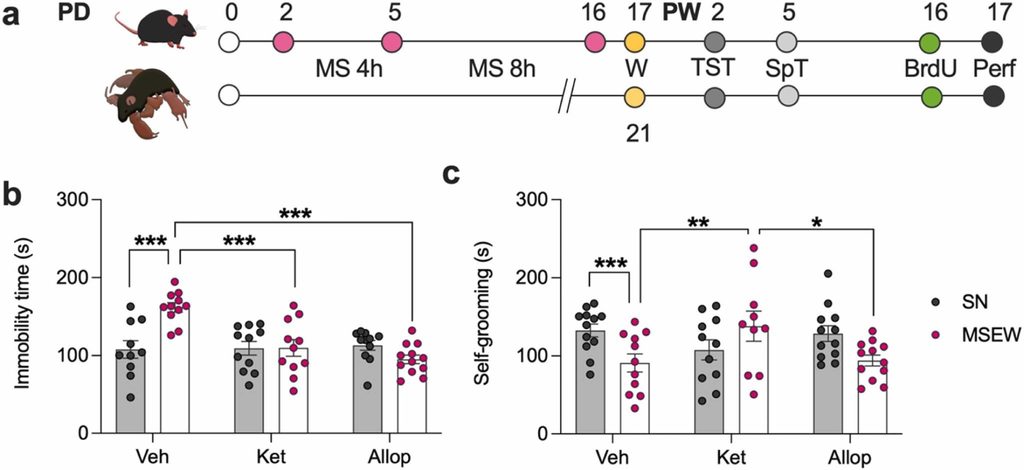
Adapted from García-Baos et al., Figure 2B and 2C. (B) Tail suspension test shows immobility time significantly decreased in MSEW females with ketamine or allopregnanolone treatment compared to vehicle (Standard nest, SN) (p < 0.001). (C) Self-grooming behaviors significantly increased in MSEW females after ketamine or allopregnanolone treatment (p < 0.05).
The results revealed that while both drugs effectively reverse depressive-like behavior, they recover the brain in different ways:
- Both ketamine and allopregnanolone rescued despair-like behavior.
- Only ketamine rescued anhedonia
- Only allopregnanolone restored synaptic infrastructure
ADVANCING REPRODUCTIVE PSYCHIATRY
Because PPD presents differently in women, individualized treatments may be necessary. While synthetic allopregnanolone actively rebuilds the brain’s molecular balance, ketamine offers rapid behavioral relief from anhedonia. Understanding where these pathways diverge opens the door for personalized interventions or combination therapies during a critical window for both mother and infant.
As reproductive psychiatry advances, pairing behavioral research with precise biological detection tools will remain vital for transforming complex physiological data into better care for maternal health. Learn more about other reproductive research discoveries utilizing Arbor Assays kits today.
By: Deanna Cannizzaro
Edited by: Francisco Torres Torres and Charukesi Sivakumar
Featured Products
-
 In Stock
Allopregnanolone ELISA Kit
Price range: $505.00 through $2,017.00The DetectX® Allopregnanolone ELISA Kits measure allopregnanolone in a variety of samples.
Related Products
-
 In Stock
Oxytocin ELISA Kit
Price range: $573.00 through $2,291.00The DetectX® Oxytocin ELISA Kit is designed to quantitatively measure Oxytocin present in serum, plasma, clarified milk and tissue culture media samples.
-
 In Stock
Oxytocin Chemiluminescent ELISA Kit
Price range: $601.00 through $2,401.00The DetectX® Oxytocin Chemiluminescent ELISA (CLIA) Kit is designed to quantitatively measure Oxytocin present in serum, plasma, clarified milk and tissue culture media samples.
-
 In Stock
Progesterone ELISA Kit
Price range: $346.00 through $1,388.00The DetectX® Progesterone ELISA Kits quantitatively measure Progesterone present in extracted dried fecal samples, urine and tissue culture media samples. Used in determination of Reproduction and Sex Steroid Metabolism