
When Behavior Drives Biology: Mating Activates Hormones in Male Frogs
Decades of comparative endocrinology research have shown that hormones shape animal behavior. However, far fewer studies demonstrate the reverse: that a discrete behavior can rapidly trigger endocrine changes. Amphibians, with their conserved neuroendocrine pathways and experimentally tractable behaviors, provide a robust system for exploring this bidirectional relationship.
In a brand new Hormones and Behavior study, Freiler et al. demonstrate that a single reproductive behavior—amplexus—rapidly activates the hypothalamic–pituitary–gonadal (HPG) axis in male Cope’s gray treefrogs (H. chrysoscelis). The researchers showed that mating behavior alone elevates testosterone and estradiol, but not corticosterone, providing one of the clearest causal demonstrations of behavior-driven hormone secretion in a vertebrate model.
Frogs are a Window into Conserved Endocrine Pathways
Amphibians occupy a key position in the study of endocrine regulation. Their HPG axis closely parallels mammalian reproductive pathways, while the amphibian hypothalamo-pituitary-interrenal (HPI) axis functions as the analog of the mammalian hypothalamic–pituitary–adrenal (HPA) axis, governing glucocorticoid release and stress physiology.
Across vertebrates, reproduction requires balancing energetic demand with stress regulation. While correlational field studies have linked mating to hormone fluctuations in birds, reptiles, and mammals, few systems allow researchers to isolate the hormonal consequences of a specific behavior experimentally. Frog amplexus, a discrete, energetically demanding mating action where the male clasps the female to boost external egg fertilization, provides a unique opportunity to test this relationship directly.
Experimental Design of Mating Behavior
To isolate behavioral effects from environmental and seasonal confounds, male H. chrysoscelis were assigned to one of three conditions:
- Amplexus induced: males allowed to enter amplexus
- Amplexus terminated: males removed from an ongoing amplexus
- Control: males prevented from mating
After 90 minutes, plasma samples were collected to quantify hormone levels. This design enabled a direct test of whether performing a mating behavior alters endocrine output, rather than merely reflecting pre-existing hormonal states.
Measuring Reproductive and Stress Hormones Across Species
Plasma concentrations of three steroid hormones were quantified using DetectX® ELISA kits from Arbor Assays:
- Testosterone – Testosterone ELISA Kit (K032-H)
- Estradiol (17β-estradiol) – Estradiol ELISA Kit (KB30-H)
- Corticosterone – Corticosterone ELISA Kit (K014-H)
These assays all feature high sensitivity, validated extraction protocols, and broad species compatibility, all of which are critical features for wildlife and comparative endocrinology research. The same core immunoassay platforms used here are routinely applied across amphibians, reptiles, birds, mammals, and fish.
Reproductive Hormones Increase Without Engaging Stress Pathways
The researchers determined that mating behavior selectively activates the reproductive axis in male frogs without triggering a parallel stress response.
Males allowed to enter amplexus showed significantly elevated levels of testosterone and estradiol compared to both control males and males removed from amplexus. Within 90 minutes, gonadal steroid levels increased by approximately 25–34%, providing direct experimental evidence that reproductive behavior rapidly stimulates HPG-axis activity.
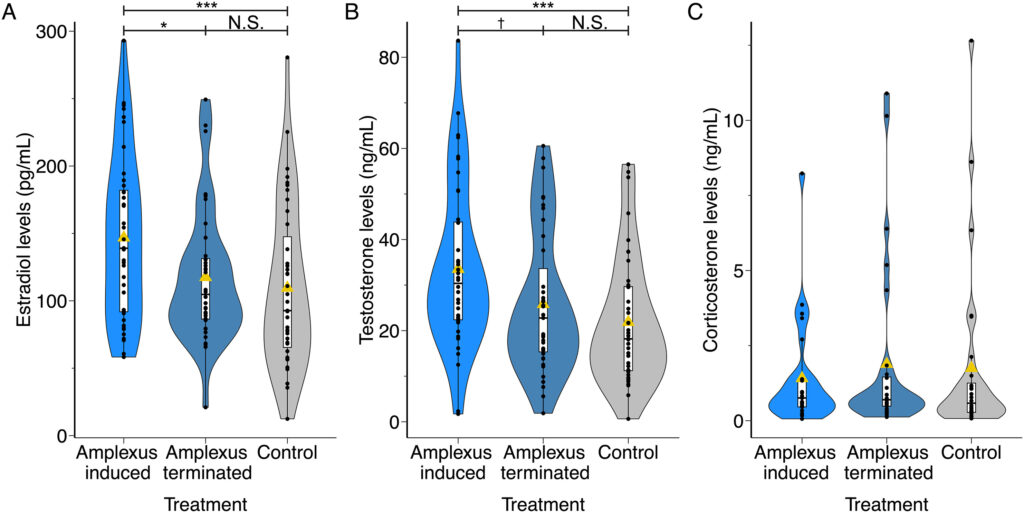
In contrast, corticosterone (CORT) levels remained unchanged across treatments, indicating that the HPI axis was not measurably engaged during this early mating window. Together, these findings show that reproductive behavior can upregulate gonadal hormone secretion without initiating a generalized stress response.
Interpreting Axis-Specific Hormone Regulation Across Vertebrates
Rather than assuming reproduction and stress hormones rise together, this work supports a more nuanced model in which HPG and HPI/HPA axes can be independently regulated. In some vertebrates, glucocorticoids are elevated later during sustained reproductive effort to meet energetic demands. The absence of a corticosterone response here suggests frogs may initially prioritize reproduction while buffering stress pathways that could interfere with mating success.
Similar patterns of axis-specific regulation have been reported across birds, reptiles, and fish, reinforcing amphibians as valuable comparative models for studying conserved endocrine systems. By experimentally isolating behavior as the trigger, this study strengthens causal links that are often inferred but rarely tested across vertebrate taxa.
Enabling Cross-Species Discovery in Hormone Research
This study highlights a practical reality of comparative endocrinology: biological insight depends on assays that perform reliably across species, sample types, and experimental constraints. Wildlife researchers often work with limited plasma volumes, non-model organisms, and highly variable physiological baselines, making assay robustness essential.
The successful use of Arbor Assays’ hormone ELISA kits in Hyla chrysoscelis—alongside their established application in mammals, birds, reptiles, and fish—demonstrates how species-agnostic immunoassays enable meaningful comparisons across the animal kingdom. By enabling accurate hormone quantification across diverse systems, these tools allow researchers to focus on biological questions rather than on methodological limitations.
Explore more peer-reviewed publications using Arbor Assays kits in our publication database.
Featured Products
-
 In Stock
Testosterone ELISA Kit – Improved Sensitivity
Price range: $429.00 through $1,717.00The DetectX® Testosterone ELISA Kits measure testosterone without extraction in serum and plasma, as well as in urine and dried fecal extracts.
-
 In Stock
Estradiol ELISA Kit
Price range: $328.00 through $1,309.00The DetectX® Estradiol ELISA Kits use a specifically generated antibody to measure estradiol and its metabolites in urine and fecal samples. This kit is not recommended for serum, plasma, or saliva samples.
-
 In Stock
Corticosterone Multi-Format ELISA Kit
Price range: $375.00 through $1,499.00The DetectX® Corticosterone Multi-Format ELISA Kits quantitatively measures corticosterone present in a variety of samples.